Sunday, November 24, 2013

How To Build A Cat Box

We've been adopted.

About a week and a half ago, a very sweet stray kitty saw the giant "SUCKER" written on my forehead in ink only visible to animals, and latched on.

A few problems, though: 1) We already have two cats, one of whom has severe vaccine reactions and cannot be vaccinated, so little kitty can't come in our house with her possible diseases. 2) Every no-kill shelter in the area--every single one--is buried in cats. 3) It's very, very cold outside. And...

4) I have a sneaking suspicion she's pregnant.

Right now, she's been living under our deck, and she seems fairly comfortable and warm there. However, with temperatures going down into the teens this weekend, my husband and I wanted her to have another option. Seizing opportunity, this is how you build an insulated cat box for around $20:

Step One: Bins


Sadly, I didn't have any of these lying around, but these two were fairly cheap at Kmart; the two together were only $17. If you're really hard up on cash, though, you can achieve a similar result with two cardboard boxes, wrapped with a garbage bag for water resistance. The requirements are that one must nest comfortably inside the other with both lids on and closed. Make sure there's a little wiggle room; remember, we'll be adding insulation.

Step Two: You cut a hole in that box


Both boxes, actually. This is the most labor-intensive and frustrating step. I suggest scoring the cut lines several times with an Exacto knife, punching through, and then using a serrated kitchen knife to actually cut through the plastic. Be patient, young Padawan, or you're going to crack the shit out of those bins and make them unusable. The openings should be cut so they'll match up when the boxes are nested inside each other.

Step Three: Add Insulation

Starting with the outer box, line the bottom with newspaper. Believe it or not, newspaper is actually a pretty decent insulator.

 
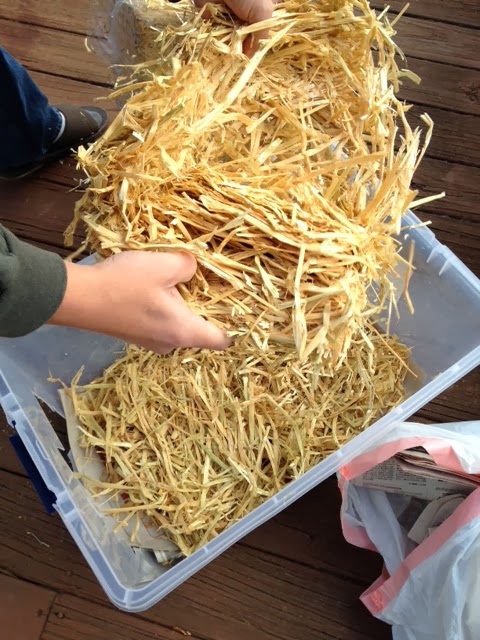
Then put a layer of straw at the bottom. Straw is also a very good insulator. I got a small bale for $3 at Michael's craft store. If you live in the country, though, I'm sure you can beg some off your neighbors. If not, you can find some at pet stores. Sawdust will work, too.


Place the smaller bin inside the larger, with the holes aligned. Line the bottom with straw...

 
 Then put newspaper on top. We did it this way so it wouldn't be so prickly.

 
The towel is optional; if you have an old one lying around, though, your stray will surely appreciate it!


Stuff as much straw between the sides of the two boxes as you can fit. Again, if you don't have straw, sawdust or even crumpled newspaper will do for this step.

 
 Before placing the lid of the outer box, add another layer of newspaper on top. Remember, heat rises!


Admire your finished box! I know the edges look a little jagged around the hole, but kitty's smart enough not to hurt herself on them. If you're worried, though, you can file them, or put a little duct tape over the points. We also added a belt of duct tape, as the box is stuffed pretty tight, and we don't want the lid popping off.
 
 
Place the box near the area where your stray has been taking shelter, but don't block her out of her current hiding place or try to force her into the box. We want kitty to feel safe and comfortable, and not frighten her away into an unsafe environment. This is her, by the way. She's cute, right? Right?You want her? ;-)


This box cost $20 and took us about twenty minutes to make. It's a small investment of time and money that could save an animal's life, so please, bookmark this post, so if you do find yourself adopted by a stray, you'll have these instructions handy. Thanks for reading!

Like me on Facebook, follow me on Tumblr, add me on Goodreads, and stalk me on Twitter!

Friday, November 8, 2013

Free Fiction Friday: Isabel, Part Four

Here are parts one, two, and three, if you missed them.

At first, Isabel didn’t think she’d be able to obey his instructions; her whole body had frozen in shock and fear, her skin gone so cold she could feel the warmth of her own sweat beaded across her flesh.  Slowly, though, her arms rose, seemingly under her own volition, above her head. A hand grasped her filthy hair roughly, knocking her hat off, and she couldn’t stifle a cry of pain as he pulled her to her feet and spun her around by the roots of her hair.

Three other men stood watching her, their dark brown faces crinkled into expressions of menace or amusement. She knew those faces; they’d been haunting the few dreams she’d had since leaving the bodies of her guides days before. The poachers.

Isabel swallowed; a useless gesture, since any moisture which had been in her mouth had dried up the minute the gun had been pressed against her neck. “I think there’s been a mistake,” she began, nervously. “I’m just trying to get to the village—I’m a scientist, I’m here to study the plants—”

The man holding her laughed sharply. “A scientist, eh? And you don’t hire any guides?” The malicious mockery in his voice sent an unexpected surge of rage up through her chest. “Do not play the fool. We know you are with the men we killed.”

“I didn’t see anything,” Isabel lied. “I still…I still haven’t seen anything.” She risked a glance at her captor’s face. “So you can let me go. No one will know about you.”

“That is not my concern,” the poacher said. “I keep the police well-paid. What is my concern…is what you have stolen from me.”

“Stolen?”

The poacher tightened his grip on her hair, pulling her head close so they were nose-to-nose. “Where is my leopard?”

Not trusting herself to speak, Isabel just widened her eyes and shook her head as much as the poacher’s hold would allow.

“Ah, she plays the fool again,” he said, relaxing his arm so Isabel could take half a step back. “My friend here, Daj—” he pointed with the gun to the man Isabel had seen inspecting the trap earlier “—he is a very talented man. A very talented tracker. He finds your tracks near our trap. He says you are probably nearby, watching. So we pretend to leave, and then follow you when you go. Because we want our leopard.”

“How do you even know there was ever a leopard in the trap?”

“Tracks,” the poacher replied. “And blood. Daj can smell from the blood what animal it comes from. Very talented man.” He paused thoughtfully. “Do you know how much leopard skin costs? Very many dollars, American dollars. So, when we lose leopard, we lose money. We cannot feed our families. And Daj’s wife is pregnant yet again.”

“How can you think that I—”

“No more playing the fool!” Her captor thrust Isabel roughly away, so she went sprawling into the leaves. When she looked up, he had his gun pointed at her, his lips curled in an angry snarl. “You will pay us for the leopard, or—”

But he never got to tell Isabel what her second option was, because a streak of yellow, black and white sailed out of the forest and knocked him to the ground. The gun went off, kicking up a divot of black loam an inch from Isabel’s side. When she looked up, she saw Daj raise his assault rifle and point it at the leopard.

“No!” Isabel screamed, and flung a stick at Daj. It wasn’t a very good throw, or a very big stick, but it hit him in the shoulder and made his attention waver for a split second, long enough for another, smaller streak to leap in from the side and catch him by the throat, throwing him to the ground.

The other two men seemed confused, unsure of what to do. They raised their rifles hesitantly, but both leopards were so entwined with their victims, there was no hope of shooting one without hitting the other.

At last, the man who had been holding Isabel lay still, and the leopard raised its bloodstained muzzle and looked right at Isabel. Their eyes locked in complete understanding.

Out of the corner of her eye, Isabel saw that one of the remaining poachers seemed to have rediscovered his courage, and was raising his rifle yet again. With a low growl, the leopard crossed in front of Isabel—still limping on her front paw—and stood between her and the poachers, head lowered and haunches tensed in a very deliberate gesture.

The poachers looked at the leopard, standing protectively in front of Isabel, its flicking tail actually touching her leg, looked at each other, and turned and ran, sprinting off into the forest.

The leopard grunted to call her cub. It left off viciously shaking Daj’s limp form and rejoined its mother with a soft chirp. Before Isabel could draw another breath, they were both gone.

 
A week and a half later, Isabel was walking through the markets of Kuching, her eyes passing over the colorful silks and fruits without much interest. She’d spent a lot of time here, killing time between interviews by the police and Embassy investigators. Her caseworker at the Embassy, Amy, had assured Isabel she would be home by the end of the week, but Isabel wasn’t holding her breath.

She passed the ‘animal stall,’ selling terrified exotic animals, with her usual disgust, until something caught her eye. A new cage, right out front, with several interested spectators lined up in front of it. She peered around the sari of one woman, and her heart froze. A tiny, dirty leopard cub was curled in fear in one corner of the cage.

Isabel shouldered through the crowd and squatted down by the cage. The cub had its back wedged so firmly into the back corner of the cage that its skin bulged out between the wire. Its eyes, pupils dilated in fear, landed on Isabel.

Isabel looked up to find a mostly-toothless man in a sarong and button-down shirt staring down at her.

“English?” she asked, and he nodded suspiciously. “How much?” she asked, pointing to the cage with the leopard.

“You cop?”

Isabel sighed. “No, I’m not a cop.”

A small smile began to curl the corners of the man’s lips. “American dollar?”

Isabel nodded.

“Five hundred!” he proclaimed proudly. Isabel snorted.

“One fifty,” she said.

“Four hundred!”

“Two.”

“Two fifty!”

Isabel stood, pulling her travel wallet, which hung around her neck, out from under her shirt. “Done,” she said, counting out the money and handing it to the man. As he recounted it eagerly, Isabel hooked her fingers through the top of the wire and began to lift the cage.

“No, no!” the man said. “Cage extra fifty.”

“You suck,” Isabel muttered under her breath, as she searched for the latch. As she opened the top of the cage, the cub pushed itself even more firmly against the wire, hissing menacingly.

“You’re all right, you’re all right,” she murmured, getting her hand close enough to stroke the top of the leopard’s head with one finger. The poor thing couldn’t have been more than six weeks old. She gently grasped it by the scruff of the neck and lifted it out of the cage, settling it against her chest. The cub’s nostrils flared as it took in her scent.

“You going to freak on me?” she murmured. The leopard seemed to take a few more moments to decide before burying its head under her armpit.

“Okay,” she said, smiling. “Still more baby than tough guy.”

 
The taxi waited for her as she asked outside the Kuching Wildlife Rescue, named for the city despite the fact that it was two hours outside the city limits. The taxi was comparatively expensive, but Isabel couldn’t imagine having made that trip on a bus…not with a squirmy leopard cub determined to hide under her shirt or in her pants. She pushed through the rusty front gate and down a wide dirt track, toward a series of enclosures and squat bamboo huts.

“May I help you?” A smiling woman, dressed in a sari, with a long, dark braid trailing over her shoulder to her waist, stood next to a tree, hands folded.

“Um, yes,” Isabel said, trying to wrestle the reluctant cub out from under her now irreversibly stretched out shirt. “Do you accept refugees?”

The woman’s eyes widened as the leopard cub appeared, growling at the loss of his hiding place. “Why don’t you come into the office?” she said, gesturing to a hut behind her.

The woman introduced herself as May; Isabel thought she had probably anglicized it from something less pronounceable. She made Isabel a cup of strong, hot tea and listened to her story without comment.

When Isabel was finished speaking, May took a sip of tea.

“That is quite an experience,” May said. “And this is why you…?” She gestured to the leopard cub’s tail, the only visible part of the animal, since it had re-ensconced itself safely under Isabel’s shirt.

“Yes,” Isabel said. “I know you’re not supposed to buy the animals like that, it just makes the poachers go out and hunt more, but…”

May nodded. “In the wider sense, yes, it is not good to do. However, in the smaller sense…the cub most likely would have been bought by someone who would have kept it in a small cage until it grew large enough to produce a profitable pelt. For this animal, it was the right thing to do.”

“Can you take him?”

May smiled. “We never turn any animals away. Of course, we could unfortunately not reimburse you your investment…”

“No, of course not. And,” Isabel pulled her wallet out of her shirt again, evoking a growl from the cub. She pulled out two more one hundred dollar bills and laid them on the table. “I’m sure he’ll have a pretty big appetite.”

May eyed the money with a look of relief. “I cannot even begin to thank you for your kindness.”

“Not at all.” Isabel pulled the cub out of her shirt and held him up to her face. “Good luck, buddy,” she said. She made to hand the cub to May, but caught a glimpse of a Polaroid camera on a small table nearby. “Would you mind taking a picture? I could pay you for the film.”

May waved her hand dismissively and got up to get the camera. “Not at all,” she said. Isabel held the cub up to her face and smiled while May took the picture. When the film came out, she handed it to Isabel. “Thank you again.”

Isabel took the picture, handed over the cub, and walked slowly back to the cab, feeling light and fulfilled, as though she’d discharged at least a part of her debt.

I hope you enjoyed this little story of mine! Come back next Friday, and I'll tell you another. And don't forget...you can always click on the links to the right to buy my book, Blind Study. See you next week!

Like me on Facebook, follow me on Tumblr, add me on Goodreads, and stalk me on Twitter!

Tuesday, November 5, 2013

For The Love Of Characters

I don't usually do posts about writing. Personally, I feel that writing is like parenting...it's an experience and a craft individual to parent and child, or writer and project, as it were. There are some basic rules, but overall it's up to you to figure out how to do it.

However, I'm watching this show right now, Sleepy Hollow, and it's got me thinking quite a bit about storytelling. See, Sleepy Hollow's got quite a few problems. Plot holes you could fly a 747 through, a major arc which has been presented but for the most part ignored...I could go on. Honestly, if it were any other show, I'd have turned it off by now.

But Sleepy Hollow isn't any other show. It's got Lieutenant Abbie Mills, possibly the strongest female lead on TV right now. She's tough, she kicks butt, and yet she's also got past demons and vulnerability which don't compromise any of the former.

Then there's Ichabod Crane, a guy as impossible as his name. Redcoat-turned-revolutionary, Rip-van-Winkled by his witchy wife and resurrected in the 21st century. He's passionate and stubborn and fiercely loyal, and I could probably continue watching Sleepy Hollow if it was a show only about Ichabod investigating the wonders of the modern world.

This is how you get me to pay attention. This is how I can be persuaded to overlook history rewritten and the realm of probability stretched thin enough to see daylight through. (And yes, I'm aware it's a show about a headless horseman of the Apocalypse. I'm not asking that the story be written within this world; I'm asking that the writers make rules for their world and then follow them. A topic for another day, possibly.)

This is how you get me to care what happens next. Create a character I fall in love with. Make them flawed. Give them demons. Have them make crappy decisions. Wound them and leave them dying on the floor. Because every time Abbie's doe eyes fill with tears or Ichabod is once again gasping his last, I want to jump in that story and fix it for them. I've been made to love them. Now it doesn't matter how many other rules the writers break. I'll notice, and I'll roll my eyes, but I won't change the channel. I won't leave them.

That's the crucial difference between a story that's okay or good or a story that OMG I LOVE SO MUCH HAVE YOU READ THIS YOU HAVE TO READ THIS HERE I BOUGHT AN EXTRA COPY READ IT READ IT NOW. Without characters you care about just as much as real people, a story's just...a story. A fable, a parable, a dry paragraph on the page of a history book. It'll pass through you without making an impression. A real story leaves claw marks on your heart.


Like me on Facebook, follow me on Tumblr, add me on Goodreads, and stalk me on Twitter!

Friday, November 1, 2013

Free Fiction Fridays: Isabel, Part Three

If you need to catch up, click through for Part One and Part Two.

As soon as it was light enough to see, Isabel checked her snares. She’d had luck again, as she’d caught two more moonrats out of four traps. Both leopards were just as happy to see these as the other two. They chomped busily away, Isabel eating a durian fruit, when a gunshot rang out, startling the jungle into a symphony of discordant shrieks, whistles and howls. Isabel dropped her fruit; both leopards sprang to their feet, the mother leopard with her trapped paw extended from her body, so she didn’t put any weight on it.

“They’re coming,” Isabel whispered. The shot they’d just heard was probably the poachers finishing off another trapped animal a mile or two down the road. Isabel scrambled across the stream, just as the mother leopard grunted softly to her cub. With several backward glances at its mother and Isabel, it slunk off into the creepers.

Isabel knelt down just outside what she thought of as the ‘leopard’s circle’. Heart pounding, she looked at the leopard, whose eyes were still focused in the direction of the gunshot.

“I know you don’t trust me,” Isabel said. “I know I’m one of them. But you have to let me help you. You know that, don’t you?” The leopard turned and looked at Isabel, her yellow eyes inscrutable.

The leopard stood about a foot and a half away from the edge of her six-foot across circle, which meant that Isabel had to come well inside the animal’s strike range. She crawled slowly, on hands and knees, to the point where she could just reach the release plate of the jaw-hold trap. Bit by bit, she extended her arm, her eyes never leaving the cat’s face.

Up until this point, the leopard had remained perfectly still except for the white tip of her tail, which twitched as she watched Isabel’s approach. Now, as Isabel’s hand came close to her foot, the leopard pulled back slightly and swiped at Isabel’s arm with her good paw, lip curled in a warning snarl. Isabel snatched her arm back to her chest, but luckily the swipe had been a statement, not a true attack.

Another gunshot.

“Please,” Isabel said, meeting the leopard’s eyes. “Please.” They stayed there for almost a full minute, Isabel on her knees, the leopard a few feet away in a half-crouch, their eyes locked.

It was the leopard who broke eye contact first. With a grunt, she lay down, her trapped paw extended, her other paw tucked beneath her chest. A peace gesture. Or so Isabel hoped.

She edged forward again, extending her arm once more, watching the cat for any sign of a reaction. There was none. After what seemed like an eternity, her fingers touched the release pad. Isabel took a deep breath and pressed.

The trap didn’t budge. It was old, dirt-and blood-caked, left outdoors in several monsoon seasons, and the parts simply weren’t gliding against each other like they used to. Isabel pressed with her fingers until she thought her knuckles would crack, but the pad didn’t give an inch.

With a shaky gulp, Isabel inched closer, until she was kneeling right next to the trap. The leopard’s whiskers were mere inches from her arm; she could feel warm breath tickling the hairs below her elbow. Isabel straightened up, placed her hands one atop the other on the pad, fingers interlaced, and pushed down with all her weight.

The trap groaned open, and before Isabel could even turn her head, the leopard was gone, a spotted flank and white-tipped tail disappearing into the green.

Isabel stayed in her position, kneeling by the trap, her eyes focused on the place she’d seen the leopard disappear, not even aware she was smiling, before the sound of a not-so-faraway human voice snapped her out of her reverie. She crossed the stream and grabbed her pack, then jogged several hundred meters back in the jungle and threw herself down under a curtain of creepers, still grinning.

There was a soft rustling in the distance which grew louder as the minutes passed. At last, four men stepped into Isabel’s vision, whom she immediately recognized as the four who’d killed her guides.

Three of the men gave angry shouts at the sight of the sprung trap, but the fourth simply went quietly to the steel jaws and squatted down, brows knit in concentration. He ran his forefinger on the inside of the closed trap, then held his hand up to his face, rubbing his thumb and finger together.

The other three men had stopped talking, and were intently watching this fourth man as he directed his attention away from the trap and toward the ground. His dark eyes scanned the disturbed leaves of the forest floor. Suddenly, he reached out and gingerly traced a shape in the dirt with his pinky. He looked up at his companions and said a few quiet words in Luru.

A subdued tension fell over the group. One of the men still standing snapped a question at the man who still squatted on the forest floor. The first part of his response was phrased seriously, then a slow smile spread over his face for the second.

Two of the men still standing laughed, and the third just smiled and shrugged. The fourth man stood, and they walked back the way they came, disappearing into the forest.

As the jungle noises slowly trickled back on after the men’s departure, Isabel let out a harsh breath and let her forehead fall onto her folded hands. Even though her fear of the poachers was still making her heart race, a thrill of rebelliousness prickled under her skin. They’d taken something from her; she’d taken something from them. They still weren’t anywhere near even, but it was still a victory, something to keep her going on her grueling journey back to civilization. She wriggled out from under the bushes, brushed herself off, and set off the way she’d been going, the opposite direction from the poachers.

Around mid-afternoon, Isabel found another small stream and dropped her pack for a short break. She mixed some iodine tablets with a fresh bottle of water, drank the whole thing down, and then made up a new one, putting it into the side pocket of her backpack. She took off her hat so she could fix her ponytail, grimacing at the film of sweat and dirt soaked into every strand of her light brown hair. Civilized women took things like clean hair and toilet paper for granted. She worked her fingers experimentally through a snarl, realized all she was accomplishing was ripping her hair out by the roots, and twisted the whole tangled mess into a wild bun at the back of her neck. She would have to soak her head in a bucket of detangler for three days to get this mess out.

Isabel looked around her and spied a durian tree. Her stomach cramped. A diet heavy in fruit was wreaking havoc on her digestive system; most of the vegetables she was finding now required cooking. She could happily kill someone for a steak and a baked potato. With a sigh, Isabel gathered three of the fruits to put in her pack, knelt quickly by the stream to freshen her protective layer of mud, and set off once more.

She’d just stepped over the stream, though, when a prickling sensation on the back of her neck made her whirl around and peer into the forest. She squinted into the thick, leafy green, trying to discern a flash of movement, a patch of color that didn’t belong.

She saw nothing.

You know, Isabel thought, your parents spent about a hundred thousand dollars of college tuition on your mind. They’ll probably be pretty annoyed if you lose it in the middle of the Bornean jungle.

Shaking her head, she turned and was on her way.

By her estimate, Isabel had about two more days of walking before she reached the small village she and her guides had set out from. Someone there could probably arrange transport for her back to the city, and once there the Embassy could get in contact with her university, get Professor Keegan on the phone so she could explain everything that had happened. Keegan was in charge of several field biologists, and had been for years; she often thought of him personally, and not the university itself, as base camp. He’d be able to sort everything out. After all, it wasn’t as though she only had to worry about getting out of Borneo a month early; there was the investigation of three murders which had occurred in the presence of a foreigner to think about. She’d probably need a lawyer.

Her stomach growled, and Isabel stopped, kneeling and swinging her pack off her shoulders to dig for the fruit she’d gathered earlier. She should probably think about setting up camp for the night soon…

Isabel was so lost in thought, she didn’t hear the man approaching until the steel barrel of his gun was pressed to the base of her neck.

“Take your hands off the pack,” said a heavily accented male voice. “Move very slowly.”

Tune in next week for the conclusion!


Like me on Facebook, follow me on Tumblr, add me on Goodreads, and stalk me on Twitter!

Friday, October 25, 2013

Free Fiction Fridays: Isabel, Part Two

If you need to catch up, click here for Part One. Otherwise, please to enjoy the second installment!

Seconds passed, and Isabel’s throat remained intact. Carefully, she pushed herself up to a sitting position and looked across the stream.

The leopard now lay with its back to her, legs splayed unnaturally. Curious, but still cautious, she stood up—and discovered the reason she was still alive.

The cat angrily gnawed at one front paw, encased in a heavy steel jaw-hold trap. The trap was anchored by three feet of thick chain attached to a stake driven into the ground. The leopard must have sensed Isabel’s movement, for it whirled around to face her once more with ears pressed flat against its head, snarling angrily.

No, it’s not angry, Isabel thought, as she looked at the cat’s dilated pupils. It’s scared.

The leopard backed up jerkily, making the chain rattle, lips still pulled back from ivory daggers. Isabel felt a hot wave of sympathy wash over her. This cat wasn’t stupid, she was sure. It probably knew any human it saw at this point was coming to kill it.

The leopard’s snarling still filling the air (and the macaques screaming overhead—she now realized they hadn’t been screaming at her, but at the leopard) Isabel slowly opened her pack and extracted a small cooking pot, which she filled with water from the stream. She stepped smoothly over the stream, a move which freshened the pitch of the leopard’s snarls, and set the pot down in the leaves. Looking around, she found what she was looking for, a long branch (really, a small tree) with a wide fork at the end. She used this to push the pot of water inside the circle formed by leopard and chain, careful not to push it directly at the leopard—given its current mood, she was pretty sure it would whack the pot away with its good paw and upset it. Then she withdrew back to the other side of the stream.

Isabel knew she would have to be patient and quiet for quite some time while the leopard worked up the courage to approach the strange, shiny object full of water. How much time depended on how long the animal had been in the trap before she found it. Luckily, botanists are as a rule very patient people. They have to be—it’s literally part of the job description to sit around and watch the grass grow.

So, Isabel took her shoes and socks off to let them dry out, rested her back against a tree (checking for fire ant nests first), pulled her hat down over her eyes, and meditated on her situation. Her inner cynic immediately spoke up.

You do realize, she said, that you are hundreds of miles from anywhere, with no food, no bug spray, and no guides, on an apparent poacher’s route, and here you are, snuggled up against a tree, waiting for the leopard to give you your pot back.

I couldn’t just leave it, Isabel argued. The poor thing has been trapped within spitting distance of a stream for God only knows how long without being able to take a drink.

And what are you going to do once it’s had its drink? the cynic asked.

For this, Isabel had no rational answer. She knew what she should do; collect her pot, put it back in her pack, and continue walking, following the road from a few feet away in the jungle until she came across a village, or another traveler, one without leopard skin hanging from his pack. She knew the poachers would be back here to collect their prize, and she should really make every effort to not be here when they returned.

The fact was, though, every time she thought about leaving and turning her back on the animal, her stomach twisted into a snarled bundle. Maybe it had something to do with leaving her guides, feeling their ghostly, accusing glares, unable to do anything more for them; maybe it was just that she was a sucker for animals. But Isabel felt pretty sure that, even though she knew, she knew she had to leave five minutes ago, her feet would never obey the directive.

“Oh, Iz, you stupid, stupid woman, you,” she murmured, just as the sounds of gentle lapping reached her ears.

Against all odds, since she’d only ever seen it done and never really had the concept explained to her, Isabel had managed to catch two moonrats for the leopard with snares made from her guides’ shoelaces, which she’d taken when she left, knowing anything even roughly resembling rope can come in vastly useful in the jungle. She’d also found a fair quantity of fruit and other plants that were edible raw. The moonrats looked much more appetizing to her, despite the rotten garlic odor the possum-like animals were famous for, but she didn’t dare risk a cookfire—in her mind, that would be the equivalent of putting up a billboard for the poachers saying, “Come and get me, suckas.”

The leopard didn’t snarl this time when Isabel approached. As she stepped across the stream, she held the dead moonrats up in the air for the animal to see. Its eyes widened, but otherwise it lay stock-still, focused on the carcasses. Isabel tossed them both inside the leopard’s circle.

At once, the cat attacked the meat with a violence that made Isabel flinch back. It was tearing greedily at the first carcass, its muzzle wholly entrenched in the moonrat’s stomach, when suddenly it lifted its head and gave a low, rhythmic grunting call.

The leaves opposite of where Isabel stood parted, and out tumbled a half-grown leopard cub which, with a cautious glance at the strange two-legged creature, settled down by its mother and began devouring the second carcass.

“Good thing I set more snares,” Isabel said with a sigh.

Night had fallen, the most uneasy night Isabel had known since her guides had been killed. She’d spent each night alone without a fire so far. Fires were wonderful for scaring off wildlife, but they were also wonderful for attracting attention, and the only other people in the jungle right now other than Isabel, as far as she knew, were cold-blooded murderers, and she certainly didn’t want to risk attracting their attention.

She had plenty of experience dealing with the creepy-crawlies of the jungle. Tonight, though, Isabel was trying to go to sleep with the knowledge that, a few yards away from her in the pitch-black, two leopards were watching her, one chained, one loose. Granted, clouded leopards, the kind native to Borneo, were much smaller than their Indian cousins; this meant that the unchained leopard cub, half the size of an adult, was only about fifteen to twenty pounds. But fifteen to twenty pounds of carefully evolved and heavily sinewed predator, however inexperienced, could conceivably kill her, and if not, deal her crippling injuries which could mean the difference between getting out of here alive—or not.

Something bumped her foot, and she bit back a scream, pressing herself back against the tree she leaned against and folding her knees against her chest. She heard a soft, surprised whuff at her flinch, then soft, warm breath, snuffling over her ankle, up her calf and down her thigh. At the top of her thigh, the nose forced itself between Isabel’s leg and stomach into her lap, investigating her crotch as a dog would, then continued upward, over her stomach and chest, poking into her armpits. A damp nose was pressed against the place where her neck met her shoulder, then pushed under the angle of her jaw. Isabel’s vocal cords trembled with the urge to scream, but she miraculously managed to remain still.

The leopard cub now investigated Isabel’s right ear, its fur brushing against her cheek. Then, it turned its head so they were nose-to-nose, warm meat-redolent breath washing over Isabel’s face and flooding her nostrils.

Just as quickly as it had come, the leopard cub was gone, and Isabel’s muscles, tensed to the point of rictus, collapsed, leaving her slumped on the damp earth of the forest floor.

Tune in next week for Part Three!

Like me on Facebook, follow me on Tumblr, add me on Goodreads, and stalk me on Twitter!

Wednesday, October 23, 2013

A My Favorite Things Giveaway: Veronica Roth's Allegiant!

Hello, and welcome to my second My Favorite Things giveaway! If you read the title, you already know I'm giving away an ebook copy of Veronica Roth's Allegiant. I was going to do this anyway, but I became even more determined to do so after seeing all the problems this poor author has been through over Allegiant. First, a Canadian bookstore accidentally shipped copies of Allegiant over a month ago. Simple mistake, and honestly you can't blame the people who read it early.

Warning: Soapbox moment imminent.

However...some total toolbag leaked a digital copy of the book online. Before the links were shut down, a lot of people read it. It was a total dick move by whoever posted it, and a dick move by those who downloaded it. You can try to make all the excuses you want, but bottom line, that's stealing, not only from the author, who you as a fan profess to love, but the team of editing, publishing and marketing people who worked very hard to bring that book to life. If you're one of the people who downloaded it for free, illegally, you're a dick. Moving on.

So, here we go...throw your name in the hat via any and all of the methods listed below in the Rafflecopter giveaway below. Up for grabs is not only an ebook copy (Kindle, Nook, or Kobo) of Allegiant, but you'll also receive a copy of my book, Blind Study. It's a two-fer! Drawing will take place next Wednesday. Good luck!

a Rafflecopter giveaway

Like me on Facebook, follow me on Tumblr, add me on Goodreads, and stalk me on Twitter!
Friday, October 18, 2013

Free Fiction Fridays: Isabel, Part One

Last week, I promised you a little buried treasure, in the form of short stories which have been mouldering on my hard drive. So, on the first of hopefully many Free Fiction Fridays, I give you Isabel, part one.
 
Isabel used the front of her shirt to wipe the paste of sweat, tears and dirt off her face, jammed her wide-brimmed hat back down on top of her head, and stood up, brushing off the seat of her pants. She took one last look at the bodies of her guides, which she’d arranged neatly on the side of the rutted track, their army blankets covering their faces, then turned and walked into the jungle.

Isabel had been a few feet off the track, hidden by a curtain of jungle creepers as she collected samples of an unfamiliar moss she thought might be an undiscovered species. Her guides, by now used to the strange American girl suddenly shouting, “Oooh!” and tripping off into the jungle, chatted as they waited for her on the rutted mockery of a road. Only one of her guides, Jasraj, spoke English, and Isabel herself wasn’t much of a talker, so for the most part they simply followed her along, talking, laughing and singing in Luru. It was liberating; their voices gave her the comfort of knowing she wasn’t alone, and yet they expected nothing of her, no uncomfortable airplane-type small talk, no, “What brings you to Borneo?”

She’d been crouched down in a small gully, carefully digging her sample, and smiling as she listened to them hooting with laughter over something Prasoon said. Suddenly, the laughter had ceased, like someone had cut it off with a knife. Isabel heard Jasraj whisper something.

Then the sound of automatic gunfire shattered the silence, startling a flock of parrots into flight, their alarmed caws  and madly flapping wings mixing with the sound of the bullets to make a screaming cacophony frenzied enough to shatter the mind. Isabel threw herself face-down into her moss, pressing herself flat and hoping her khaki-green hiking gear would be enough to hide her.

A second or an hour later, the gunfire stopped. Over the pounding of blood in her ears, she heard four unfamiliar voices in Luru coming from the area where she’d left her guides. Slowly, thankful for the soft cushion of moss which wouldn’t crackle and give her away, Isabel raised her head above the edge of the gully and peered through the green.

Four men, dressed in BDU’s, kicked at the blood-spattered bodies of Isabel’s companions with dusty boots, their rifles slung over their shoulders while they picked carelessly through the dead men’s pockets and backpacks. All four were wearing large duffel-style packs, and a scrap of leopard skin dangled from the opening of the man’s pack nearest to her.

Poachers, Isabel thought. She’d seen poachers before, but only in the towns that bordered the jungles, huddled in seedy bar doorways, their flat gazes making her shudder as they passed over her breasts and further downward before turning away. This was the first time she’d ever encountered them in the jungle, and she was rapidly coming to the conclusion it might be the last.

Miraculously, though, they turned away, stepping over the bodies of her guides and chuckling quietly among themselves. They continued along the track until, finally, the jungle swallowed them up as quickly as it had regurgitated them. Isabel waited for the alarm calls of the surrounding birds and small animals to stop before crawling back to the road.

           
They had been good men, all three of them. Isabel shuddered, imagining she could feel the accusing stares of their spirits on her back, angry with her for leaving their bodies in the open for the ants and the leopards. But the small camp spade now strapped to her pack could never have dug even one grave, much less three. Not to mention the more time she spent here on the road, the more chance the poachers would return. And there would be no one to dig her grave.

 
Three days later, Isabel was in trouble. The poachers had taken most of the food that Jasraj, Prasoon, and Taran had been carrying; luckily, she’d been in such a hurry when she spotted the moss that she’d taken off into the brush, pack and all. Now, she sat by a small stream, licking the wrapper of a granola bar, the last bit of food she had. Above her, a troupe of macaques chattered loudly, leaping from branch to branch and knocking dead twigs down on her head.

The lack of food made things difficult, but not impossible; Isabel’s extensive knowledge of jungle plants meant she could probably sustain herself for a good long while. She wouldn’t be dining like a queen, but she wouldn’t starve to death, either. More worrisome was the fact that she was out of bug spray. Before she became a field botanist, Isabel would have laughed at someone being more concerned about bug spray than food. But the numbers of mosquitoes and other blood-sucking insects that swarmed in the rainforest could actually drink enough to make a person anemic, not to mention that being covered in thousands of itchy bug bites would eventually drive a person to near-insanity. And sanity was one thing that Isabel could not afford to lose, not now.

At least I’ve got plenty of iodine tablets, she thought, dropping one into the bottle of water she’d just drawn from the stream. She swished the water around inside the bottle until the tablet dissolved completely, then took a swig, grimacing at the bitter taste. She set the bottle aside and, trying not to think about the kinds of exotic bacteria that could be living in the mud of the stream bank, began smearing gloppy handfuls on her arms. Mud or malaria.

Isabel was spreading the mud across her face, eyes closed, when suddenly it felt as though someone had dropped a small, cold stone into the pit of her stomach. She was being watched. Slowly, she dropped her hands from her face, opened her eyes—and froze.

On the other side of the stream, about ten feet away, a pair of yellow eyes, narrowed in concentration, met her own. Isabel’s mind raced in mad circles around her options—back off slowly, or stay still and hope for the best? Move? Stay?

The cramping of her fatigued muscles finally made the decision for her. Knowing she was making a move that might end her life, Isabel slowly rose from her kneeling position to a low crouch.

The leopard sprang; Isabel leapt backward, but tripped over her pack and sprawled out flat on her back, hitting her head on the ground hard enough to turn the world into a sickening, spinning carnival ride. Her eyes finally focused on the light trickling down through the canopy, the macaques screaming above her. This is the moment, she thought, calmly. This is the end.

Tune in next Friday for another installment!


Like me on Facebook, follow me on Tumblr, add me on Goodreads, and stalk me on Twitter!